Αρχειοθήκη ιστολογίου

Τρίτη 19 Ιουλίου 2022

Increased sensitivity of Aggregatibacter actinomycetemcomitans to human serum is mediated by induction of a bacteriophage

alexandrossfakianakis shared this article with you from Inoreader

Summary

Aggregatibacter actinomycetemcomitans, a Gram-negative oral pathobiont causing aggressive periodontitis and systemic infections demonstrates serum resistance. We have identified a dsDNA tailed bacteriophage S1249, which was found from this microorganism inducible by human serum to convert into lytic state to kill the bacterium. This phage demonstrated active transcripts when exposed to human serum: 20% of genes were up regulated greater than 10 folds and 45% of them were up regulated 5–10 folds, when the bacterium was grown in the presence of human serum compared to without. Transcriptional activation when grown in equine serum was less pronounced. This phage demonstrated a tail with the inner rigid tubes and outer contractile sheath, features of Myoviridae spp. Further characterization revealed that the lysogenized integration of the phage in the chromosome of A. actinomycetemcomitans occurred between the genes encoding for cold-shock DNA-binding domain-con taining protein (csp) and glutamyl-tRNA synthetase (gltX). Both phage DNA integrated lysogeny and non-integrated pseudolysogeny were identified in the infected bacterium. A newly generated, lysogenized strain using this phage displayed similar attributes, including 63% growth inhibition compared to its isogenic phage-free strain when in the presence of human serum. Our data suggest that bacteriophage S1249 can be induced in the presence of human serum and enters the lytic cycle, which reduces the viability of infected bacteria in vivo.

This article is protected by copyright. All rights reserved

View on Web

Masking ability of resin composites: Effect of the layering strategy and substrate color

alexandrossfakianakis shared this article with you from Inoreader

Abstract

Objective

To evaluate the effect of layering strategy and substrate color on the masking ability of resin composites.

Materials and Methods

A1-shaded specimens from Charisma Diamond and Filtek Z350XT were produced using different layering strategies. Color measurements were made by a reflectance spectrophotometer over A2, C2, A3.5, C3, C4 substrates. Color differences were calculated and interpreted by the 50%:50% perceptibility and acceptability visual thresholds. Data was analyzed by Kruskal–Wallis and Dunn post hoc test. Chi-square test was used to determine the association between masking ability, and independent variables.

Results

Color differences were significantly lower on A2 and C2 in comparison with C4 for the majority of the layering strategies. Acceptable matches were observed on most of the combinations over A2. Moderately unacceptable mismatches were observed in most of the combinations over C2 and A3.5. Clearly unacceptable mismatches were observed on the C3 and C4. The ΔE 00 color shifts were predominantly influenced by ΔL 00 for all layering strategies and substrate colors.

Conclusion

Masking ability was affected by the layering strategy and substrate color. Acceptable masking was associated with A2 and C2, and with layering strategy composed of 0.5 mm enamel opacity and 1.0 mm dentin opacity thicknesses, using the Filtek Z350XT.

Clinical Significance

Resin composites—shade A1—applied by different layering strategies with a final thickness of 1.5 mm were able to mask mild and moderately discolored substrates. Severely discolored substrates were not masked effectively.

View on Web

The malignant property of circHIPK2 for angiogenesis and chemoresistance in non-small cell lung cancer

alexandrossfakianakis shared this article with you from Inoreader

1-s2.0-S0014482722X00141-cov150h.gif

Publication date: Available online 19 July 2022

Source: Experimental Cell Research

Author(s): Mingming Ren, Xiang Song, Jieting Niu, Guojie Tang, Zhen Sun, Yanguang Li, Fanyi Kong

View on Web

Orthopedic Surgery Causes Gut Microbiome Dysbiosis and Intestinal Barrier Dysfunction in Prodromal Alzheimer Disease Patients: A Prospective Observational Cohort Study

alexandrossfakianakis shared this article with you from Inoreader
imageObjective: To investigate gut microbiota and intestinal barrier function changes after orthopedic surgery in elderly patients with either normal cognition (NC) or a prodromal Alzheimer disease phenotype (pAD) comprising either subjective cognitive decline (SCD) or amnestic mild cognitive impairment (aMCI). Background: Homeostatic disturbances induced by surgical trauma and/or stress can potentially alter the gut microbiota and intestinal barrier function in elderly patients before and after orthopedic surgery. Methods: In this prospective cohort study, 135 patients were subject to preoperative neuropsychological assessment and then classified into: NC (n=40), SCD (n=58), or aMCI (n=37). Their gut microbiota, bacterial endotoxin (lipopolysaccharide), tight junction (TJ) protein, and inflammatory cytokines in blood were measured before surgery and on postsurgical day 1, 3, and 7 (or before discharge). Results: The short-chain fatty acid (SCFA)-producing bacteria were lower while the gram-negative bacteria, lipopolysaccharide and TJ were higher preoperatively in both the SCD and aMCI (pAD) groups compared with the NC group. After surgery, a decrease in SCFA-producing bacteria, and an increase in both gram-negative bacteria and plasma claudin were significant in the pAD groups relative to the NC group. SCFA-producing bacteria were negatively correlated with TJ and cytokines in pAD patients on postsurgical day 7. Furthermore, surgery-induced perioperative metabolic stress and inflammatory responses were associated with gut microbiota alterations. Conclusions: Surgery exacerbates both preexisting microbiota dysbiosis and intestinal barrier dysfunction in pAD patients, all of which may be associated with systemic inflammation and, in turn, may lead to further cognitive deterioration.
View on Web

NUT carcinoma of the mandible in a child: case report and systematic review

alexandrossfakianakis shared this article with you from Inoreader
This report illustrates the management of mandibular NUT carcinoma in a pediatric patient, complemented by a systematic review of head and neck NUT carcinoma. A 5-year-old female presented with an enlarging jaw mass that was diagnosed as BRD4-NUTM1 carcinoma and was treated with hemimandibulectomy and chemoradiation. (Source: International Journal of Oral and Maxillofacial Surgery)
View on Web

Δευτέρα 18 Ιουλίου 2022

Allopurinol‐induced Stevens‐Johnson syndrome and toxic epidermal necrolysis: Signal detection and preventability from Vietnam National pharmacovigilance database

alexandrossfakianakis shared this article with you from Inoreader
Allopurinol-induced Stevens-Johnson syndrome and toxic epidermal necrolysis: Signal detection and preventability from Vietnam National pharmacovigilance database

Among 72,822 spontaneous ADR reports submitted to the Vietnam National Drug Information and Adverse Drug Reaction Monitoring Centre, 392 reports were on SJS/TEN, of which, 65 cases (16.6%) were related to allopurinol. The signals of allopurinol-induced SJS/TEN in Vietnam started in 2014 (ROR of 3.531, 95% CI: 1.830–6.810) and annually increased until 2019 (ROR of 11.923, 95% CI: 8.508–16.710). The preventability assessment showed that no allopurinol-induced SJS/TEN case was definitely unpreventable. 61.6% of the SJS/TEN cases were avoidable because they were associated with inappropriate prescribing such as unapproved indications, too high initial dose and even rechallenging in patients with a history of allopurinol allergy.


Abstract

What Is Known and Objective

Allopurinol, the first-line medication for hyperuricemia is well-known for its association with severe cutaneous adverse reactions, especially Stevens-Johnson syndrome (SJS) and toxic epidermal necrolysis (TEN). In the current study, we analysed the Vietnamese spontaneous reporting database to identify signals and preventability of allopurinol-induced SJS/TEN in Vietnam from 2010 to 2019.

Methods

Signal generation was assessed using the case/non-case method. Reporting odds ratios (RORs) and 95% confidence intervals (95% CI) were calculated.

Results

Among 72,822 spontaneous ADR reports submitted to the Vietnam National Drug Information and Adverse Drug Reaction Monitoring Centre, 392 reports were on SJS/TEN, of which, 65 cases (16.6%) were related to allopurinol. The signals of allopurinol-induced SJS/TEN in Vietnam started in 2014 (ROR of 3.531, 95% CI: 1.830–6.810) and annually increased until 2019 (ROR of 11.923, 95% CI: 8.508–16.710). The preventability assessment showed that no allopurinol-induced SJS/TEN case was definitely unpreventable. 61.6% of the SJS/TEN cases were avoidable because they were associated with inappropriate prescribing such as unapproved indications, too high initial dose and even rechallenging in patients with a history of allopurinol allergy.

What Is New and Conclusion

The signals of allopurinol-induced SJS/TEN in Vietnam started in 2014 and annually increased until 2019. Our first report specifically focusing on the ADR preventability of allopurinol showed that correction of medical errors relating to prescription could prevent more than 60% of SJS/TEN cases in Vietnamese allopurinol users. This is a feasible and practical solution, provided that there would be a systematic change in both healthcare systems and public awareness.

View on Web

Long-term exposure to low-level air pollution, genetic susceptibility and risk of dementia

alexandrossfakianakis shared this article with you from Inoreader

m_dyac146f1.jpeg?Expires=1721224181&Sign

Abstract
BackgroundWe aimed to assess the association between low-level air pollution and the risk of dementia, and examine the modification effect by genetic susceptibility on the relationship.
Methods
A total of 164 447 participants who were free of dementia at baseline and aged ≥60 years were included. Annual average concentrations of particulate matter (PM) with diameters of ≤2.5 μm (PM2.5), between 2.5 and 10 μm (PMcoarse), PM2.5 absorbance and nitrogen dioxides (NO2) were evaluated using the Land Use Regression models. Cox proportional hazards regression was used to estimate the association between air pollutants and incident dementia.
Results
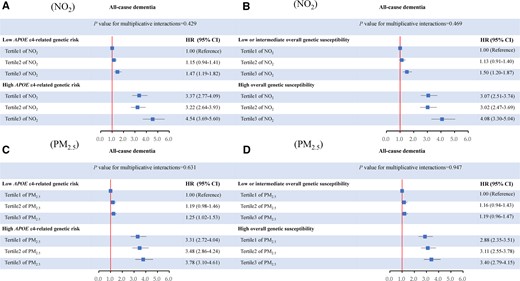
The adjusted hazard ratio (HR) of dementia for a 5-μg/m3 increase in NO2 was 1.09 (95% CI, 1.05–1.14); the adjusted HR of dementia for a 1-μg/m3 increase in PM2.5 was 1.10 (1.04–1.17). Such significant associations were present even within concentration ranges well below the present World Health Organization, US and European annual mean limit values. In addition, higher PM2.5 absorbance, a marker closely related to motorized traffic, was associated with higher risk of dementia. We found the risk of dementia associated with a combination of air pollutants (NO2 or PM2.5) and high genetic susceptibility (APOE-ε4 alleles or overall genetic susceptibility) was greater than the addition of the risk associated with each individual factor, indicating significant interactions on an additive scale (all P-interaction < 0.05).
Conclusion
Long-term exposure to PM2.5 or NO2, even at relatively low levels, is associated with a higher risk of dementia. Air pollution may additively interact with the genetic susceptibility on dementia risk.
View on Web

Gestational Weight Gain and Birth Outcomes: A Comparison of Methods to Account for Gestational Age

alexandrossfakianakis shared this article with you from Inoreader

aje_ogimage.png

Abstract
Cross-sectional studies of total gestational weight gain (GWG) and perinatal outcomes have used different approaches to operationalize GWG and adjust for gestational duration. Using birth records from California (2007-2017), Nevada (2010-2017), and Oregon (2008-2017) we compared three commonly used approaches to estimate associations between GWG and cesarean delivery (C-section), small for gestational age (SGA), and low birth weight (LBW)]: (1) the Institute of Medicine r ecommended GWG ranges at a given gestational week, (2) total weight gain categories directly adjusting for gestational age as a covariate, and (3) weight-gain-for-gestational-age z-scores derived from an external longitudinal reference population. Among 5,461,130 births, the three methods yielded similar conclusions for C-section and SGA. However, for LBW, some associations based on z-scores were in the opposite direction of methods 1 and 2, paradoxically suggesting higher GWG increases risk of LBW. This was due to a greater proportion of preterm births among those with high z-scores, and controlling for gestational age in the z-score model brought the results in line with the other methods. We conclude that the use of externally-derived GWG z-scores based on ongoing pregnancies can yield associations confounded by duration of pregnancy when the outcome is strongly associated with gestational age at delivery.
View on Web

Κυριακή 17 Ιουλίου 2022

Effects of concentration of sodium hypochlorite as an endodontic irrigant on the mechanical and structural properties of root dentine: A laboratory study

alexandrossfakianakis shared this article with you from Inoreader

Abstract

Aim

The use of high-concentration sodium hypochlorite (NaOCl) as an endodontic irrigant remains controversial because of its potential impact on the fracture strength of endodontically-treated teeth. This study evaluated the effects of using different NaOCl concentrations, with 2-min-ethylenediaminetetraacetic acid (EDTA) as the final active irrigant, on the biomechanical and structural properties of root dentine.

Methodology

A new test method, which is more clinically relevant, was utilized to calculate the fracture strength of root dentine. Bovine incisors were used to obtain root dentine discs. The root canals were enlarged to mean diameter of 2.90 mm with a taper of 0.06. The resulting discs were divided into 5 groups (n=20) and treated with different concentrations of NaOCl (5.25%, 2.5%, and 1.3%) for 30 min plus 17% EDTA for 2 min. The discs were then loaded to fracture by a steel rod with the same taper through the central hole. The fractured specimens were examined by scanning electron microscopy to evaluate changes in the dimensions of the remaining intertubular dentine and the tubular radius. Micro-hardness was also measured with a Knoop diamond indenter along a radius to determine the depth of dentine eroded by the irrigation. Results were analyzed by one-way ANOVA and the Tukey test. The level of significance was set at α = 0.05.

Results

The damage by NaOCl increased with its concentration. 5.25% NaOCl greatly reduced the fracture strength of root dentine from 172.10±30.13 MPa to 114.58±26.74 MPa. The corresponding reduction in micro-hardness at the root canal wall was 34.1%. The damages reached a depth of up to 400 μm (p < 0.05). Structural changes involved degradation of the intratubular wall leading to enlarged dentinal tubules and the loss of intertubular dentine. Changes in the microstructural parameters showed positive linear relationships with the fracture strength.

Conclusions

With the adjunctive use of EDTA, NaOCl caused destruction to the intratubular surface near the root canal and, consequently, reduced the root dentine's mechanical strength. The higher the concentration of NaOCl, the greater the effect. Therefore, endodontists should avoid using overly high concentration of NaOCl for irrigation to prevent potential root fracture in endodontically-treated teeth.

View on Web

Response to a novel, weight self‐awareness plan used in a multi‐component lifestyle intervention programme to reduce breast cancer risk factors in older women – secondary analysis from The ActWELL trial

alexandrossfakianakis shared this article with you from Inoreader

Abstract

Background

The ActWELL RCT assessed the effectiveness of a weight management programme delivered by volunteer lifestyle coaches (LC) in women attending breast clinics. The intervention focused on caloric intake and physical activity, utilising behavioural change techniques including a weight awareness plan (WAP). The current work is a secondary analysis of the ActWELL data and aims to examine the response to the weight self-awareness plan (used as part of the intervention programme).

Methodology

The LCs invited participants (n=279) to undertake an implementation intention discussion to formulate a self-weighing (SW) plan. Bodyweight scales were offered, and recording books provided. The PA intervention focused on a walking plan assessed by accelerometers. The LCs contacted participants by telephone monthly and provided personalised feedback. Mann-Whitney tests and chi-squared analysis were used to examine the effect of SW on weight change. A qualitative evaluation utilising semi-structured interviews was also undertaken.

Results

Most participants (96.4%) agreed to set a weekly SW goal and 76 (27%) requested scales. At 12 months, 226 (81%) returned for follow up. The median (IQR) weight change for those who self- reported at least one weight (n=211) was -2.3kg (-5.0, 0.0) compared to -1.2kg (-5.0, 0.03) in those who did not (n=14). Participants who reported weights on >8 occasions (39%) were significantly more likely (p=0.012) to achieve 5% weight loss compared to those who weighed less often. Low numbers of accelerometers were returned which did not allow for significance testing. Qualitative data (n=24) indicated that many participants found the WAP helpful and motivating.

Principal Conclusion

Greater adherence to the WAP initiated by volunteer coaches is associated with achieving 5% weight loss.

This article is protected by copyright. All rights reserved.

View on Web